
Predecessors allow task dates to relate to other tasks in order to push out all impacted tasks when one end date changes.
Terms to Know:
Task: When setting up predecessors, the task dropdown will display any existing task/subtask from the task list.
Type: Predecessors will be set with a "Finish to Start" relationship by default meaning that the end date of the predecessor will determine the start date of the successor task. Additional relationship types are available in the dropdown.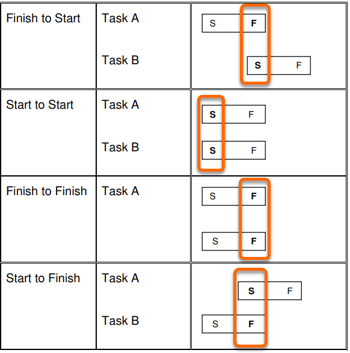
Lag (Days): Lag determines how many business days (M-F) should pass before the next task's start date.
Lag Type: Select between Business Days or Calendar Days. It is not possible to configure "working days" that account for specific work schedules or holidays.
Lag Type is not configurable via the in-line edit. Lag Type will automatically default to the Task List default set in the Task Settings. To update the Lag Type:
1. Open the Task Settings
2. Select the desired default Date Type.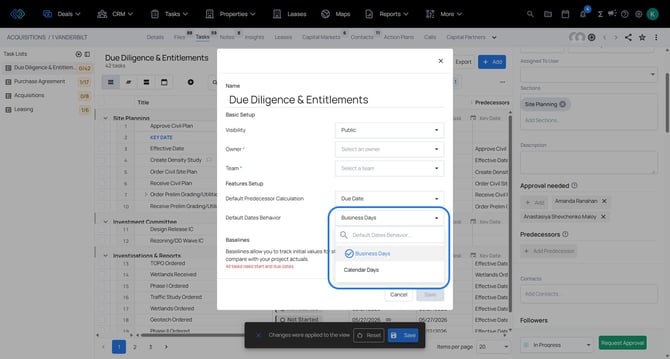
Example:
Task 1 is a predecessor to Task 2. The predecessor is set up on Task 2 as shown below.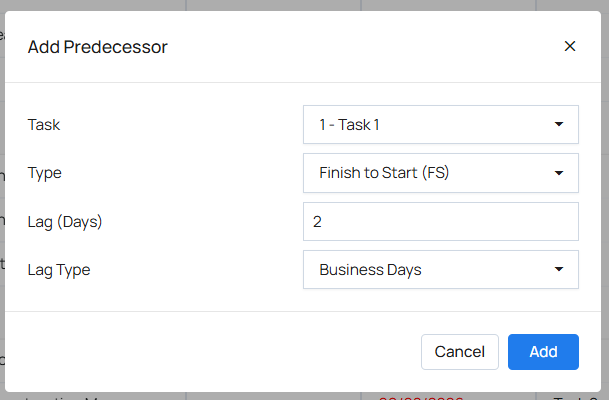
Task 1 is completed on Thursday. Task 2's start date will be updated to the following Tuesday.
| Sun | Mon | Tues | Wed | Thurs | Fri | Sat |
| Task 1 End Date | Lag Day 1 | |||||
| Lag Day 2 | Task 2 Start Date |
📑Learn To:
- Add Predecessors to Task Items
- In-Line Edit Predecessors on Task Lists
- Optional: View predecessors by Row number instead of task title
💡Things to Consider
Duration must be set on tasks for predecessors to calculate. Set duration to 0 or 1 for tasks where the start date should equal the due date. (Duration of 0 and Duration of 1 are treated the same).
Row numbers have been added to all Task Lists by default. This is a reference number to allow for a dedicated shortcut string to be entered in the Predecessor column.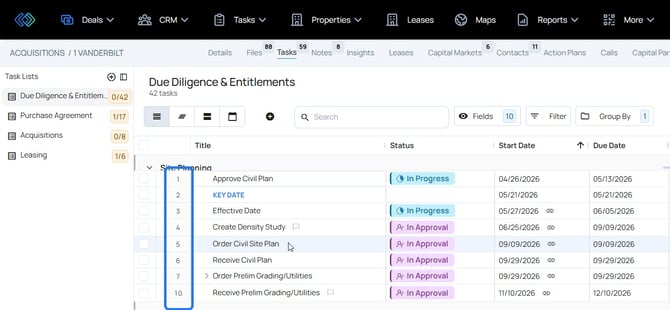
Hover over the Predecessor column header to see examples of how to enter the predecessor shortcut in app. 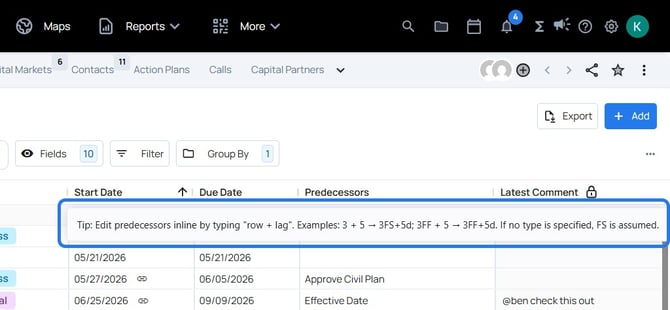
Consider adding "Predecessor Lag" as a field on the Task List View to display the predecessor type, the lag and lag type. 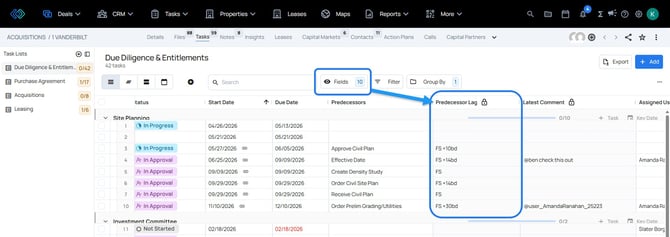
When multiple predecessors are listed, the dependent/downstream task will be based on the latest date to occur.
Example: For 'Finish to Start' predecessor relationships,the start date of the dependent task is calculated by looking at the predecessor with the due date/completion date that occurs last. It is not taking into consideration whether or not the other predecessor has been completed.
⚙️Steps
Add Predecessors to Task Items:
- Open the task item side panel on a task, subtask, or key date.
- Scroll to the Predecessors section
- Select Add
- Select the predecessor task in the dropdown. Use the dropdowns to set the Predecessor Relationship (type), Lag (days) and Lag Type. Refer to the Terms to Know to review these options.
- Select "Add"
- Repeat if the task item, subtask, or key date is dependent on multiple predecessors. When multiple predecessors are listed, the dependent/downstream task will be based on the latest date to occur. The calculation is not taking into consideration whether or not the predecessor with a sooner due date has been completed.
As tasks are completed and the end date is updated, predecessors that follow will be updated in accordance with the dependencies.
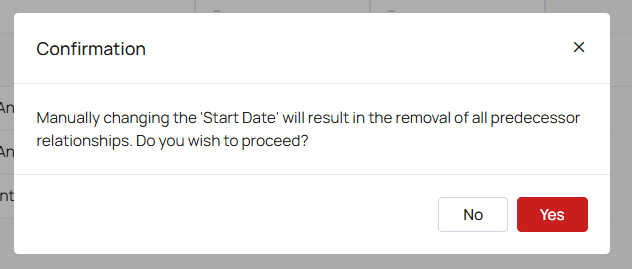
If a user attempts to change the start date of a task that has predecessors associated, all predecessor relationships for that task and downstream of that task will be removed.
In-Line Edit Predecessors on Task Lists
Tab through cells on the Task List table view to in line edit. To update predecessors, use the dedicated shortcut, entering the row number, predecessor type abbreviation (FS, SS, SF, FF), and any lag value (e.g., +2 or -2) directly within the cell. Although you can still configure predecessors within task details (Add Predecessors) entering them in the table view streamlines manual entry.
- Enable the Predecessor field on the Task List View.
- (Optional) Enable the Predecessor Lag field on the Task List View
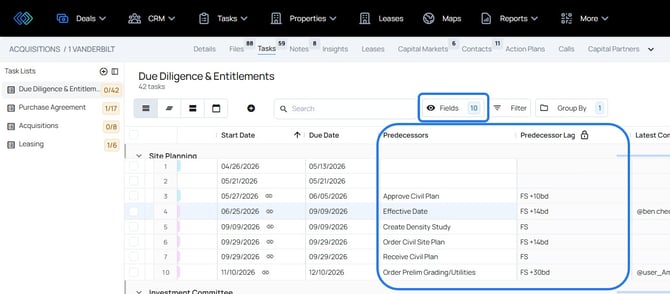
- Double click into the Predecessor cell for the task that is dependent on the predecessor.
- Enter the Row Number, followed by the predecessor type abbreviation (FS, SS, SF, FF), followed by the lag. If no predecessor type is specified, FS is applied by default.
EX: 5FS + 30 - Click off the cell or select enter on the keyboard to save the predecessor change.
The name of the predecessor task will appear in the 'Predecessors' column.
The predecessor type abbreviation and lag + lag type will appear in the 'Predecessor Lag' column
Optional: Predecessors By Row Number
There is a feature that can be enabled that displays the row number and predecessor lag in the format "Row-Predecessor Relationship Code - Lag - BD/CD"
Ex: 1FS + 2BD
Enabling this feature will change the column used to in-line edit predecessors from the task list view. When enabled, instead of entering predecessor relationships into the "Predecessor"column, they will be entered into the "Predecesor Lag" column("Predecessor" column will be a locked column).
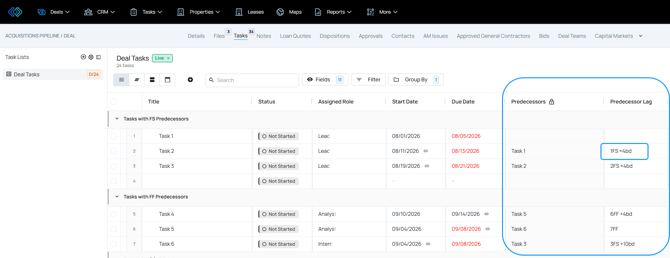
To enable this feature, reach out to your client success manager or support@termsheet.com